An IP68-rated cooling fan provides dust-tight protection and protection against water immersion under specified conditions. For your industrial or outdoor equipment, this helps protect critical fan components from environmental exposure. CCHV has obtained a third-party IP68 test report for its IP68 techniques.
What the IP68 rating means
The IP code describes protection against solid particles and water ingress. The first digit, 6, indicates dust-tight protection. The second digit, 8, indicates protection against continuous immersion under conditions specified by the manufacturer. Check the documented depth and duration rather than assuming all IP68 fans have identical protection limits.

Dust on the left represents the digit 6; water on the right represents the digit 8. Conceptual illustration only, not a photograph of the tested CCHV sample.
How protection works inside a fan
Your cooling fan needs open airflow passages to move air through equipment. Environmental protection therefore focuses on vulnerable components such as motor windings and control electronics. Encapsulation can isolate these components from dust and water while leaving the airflow path open. Confirm the protection scope for your selected model, including cable exits and connectors.
How to read the complete IPXX code
IP stands for International Protection, commonly called Ingress Protection. The two positions in IPXX describe separate protection categories under IEC 60529. Read the code as IP + first digit + second digit. The first digit ranges from 0 to 6 and addresses solid foreign objects and access to hazardous parts. The second ranges from 0 to 9 and addresses harmful water ingress.
The letter X means that a protection level is not specified for that position. It does not mean zero protection, and it does not mean the highest protection. IPXX is a generic format or a code with both numerals omitted; it is not a dustproof or waterproof performance claim.
First digit explained Solid objects and dust
| Digit | Protection against solid foreign objects |
| 0 | No protection specified by this level |
| 1 | Objects 50 mm in diameter and larger |
| 2 | Objects 12.5 mm in diameter and larger |
| 3 | Objects 2.5 mm in diameter and larger |
| 4 | Objects 1.0 mm in diameter and larger |
| 5 | Dust-protected; limited dust may enter, but not enough to impair satisfactory operation or safety |
| 6 | Dust-tight; no dust ingress under the specified test |
| X | Solid-object protection level not specified |
The first digit also addresses access to hazardous parts: levels 1 and 2 relate to the back of a hand and a finger; levels 3 and 4 relate to a tool and a wire; levels 5 and 6 also use wire-access requirements. Dust protection and protection from hazardous-part access are related but distinct checks.
Examples of codes containing X
IP6X means dust-tight, with no water protection level specified. IPX8 means immersion protection under defined conditions, with no solid-object protection level specified. IP68 declares both dust-tight and immersion protection. On your CCHV report, IP6X and IPX8 identify the two separately assessed parts of the overall IP68 test.
IP68 fans compared with unrated fans
| Feature | IP68 fan | Fan without a declared IP rating |
| Dust protection | Dust-tight within the rated scope | No verified dust protection established |
| Water protection | Immersion under specified conditions | No verified water protection established |
| Operating life | Requires separate lifetime data | Requires separate lifetime data |
Second digit explained Water protection
| Digit | Protection against harmful water ingress |
| 0 | No protection specified by this level |
| 1 | Vertically falling water drops |
| 2 | Vertically falling drops with the enclosure tilted up to 15 degrees |
| 3 | Sprayed water at angles up to 60 degrees from vertical |
| 4 | Splashing water from any direction |
| 5 | Water jets from any direction under specified conditions |
| 6 | Powerful water jets from any direction under specified conditions |
| 7 | Temporary immersion under defined depth and duration conditions |
| 8 | Continuous immersion under agreed conditions more severe than level 7; check the documented depth and duration |
| 9 | High-pressure, high-temperature water jets under specified conditions |
| X | Water protection level not specified |
Immersion protection does not automatically establish jet or washdown protection. For equipment exposed to both immersion and water jets, request evidence for both, such as IP66/IP68. IEC 60529 uses IPX9; IPX9K or IP69K designations relate to a different test framework, so check the cited standard before comparing them.
Optional letters after the digits
Additional letters describe protection against access to hazardous parts: A for the back of a hand, B for a finger, C for a tool, and D for a wire. Supplementary letters provide further information: H for high-voltage apparatus, M for moving parts in motion during the water test, S for moving parts stationary during the water test, and W for specified weather conditions. These letters are optional and are not implied by IP68.
What the rating does not establish
IP68 alone does not establish saltwater corrosion resistance, chemical compatibility, fan service life, or unrestricted powered underwater operation. It also does not give your complete cabinet an IP68 rating simply because an IP68 fan is installed. Assess the finished enclosure and its openings separately.
CCHV third party IP68 testing
For your supplier evaluation, CCHV has obtained a third-party IP68 test report for its tested 12038-series DC fan sample. Precise Testing & Certification (Guangdong) Co., Ltd. issued report PTC24062106201R-EN02 on 22 July 2024.
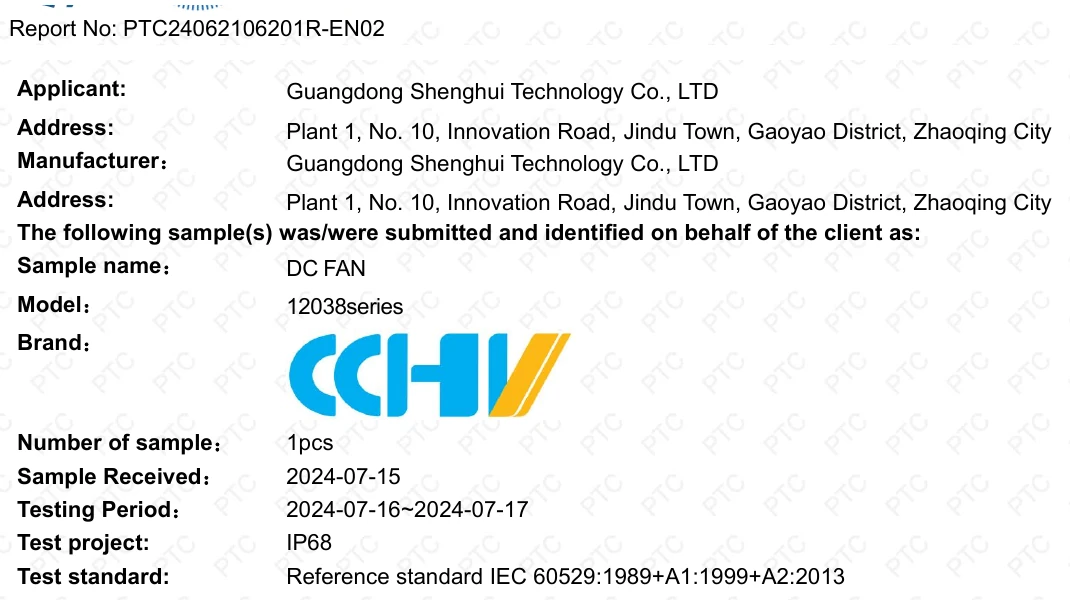
Report excerpt from page 1: report number, applicant, CCHV brand, tested series, testing dates, and reference standard.
Documented dust and immersion conditions
The IP6X dust test lasted 8 hours. The IPX8 test used pressure to simulate the lowest point of the enclosure at 2 metres below the water surface for 1 hour. These are the actual conditions documented for the tested sample.
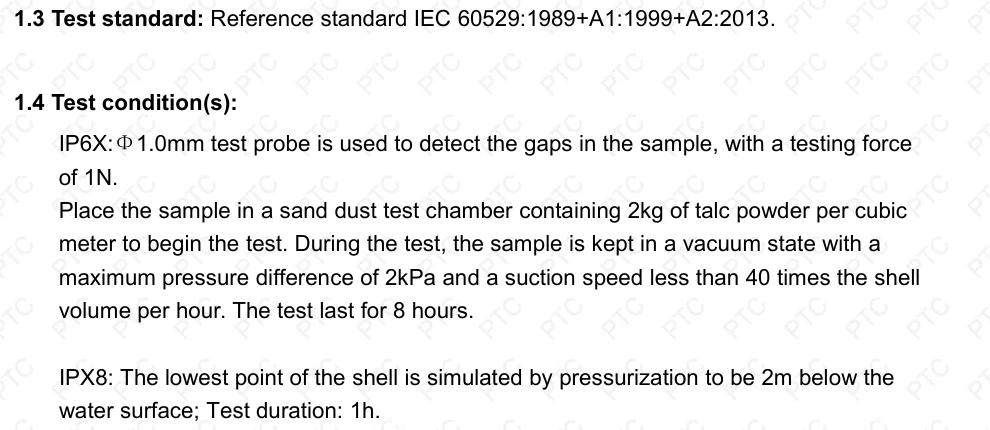
Report excerpt from page 2: test standard and IP6X/IPX8 test conditions.
CCHV test results and laboratory photos
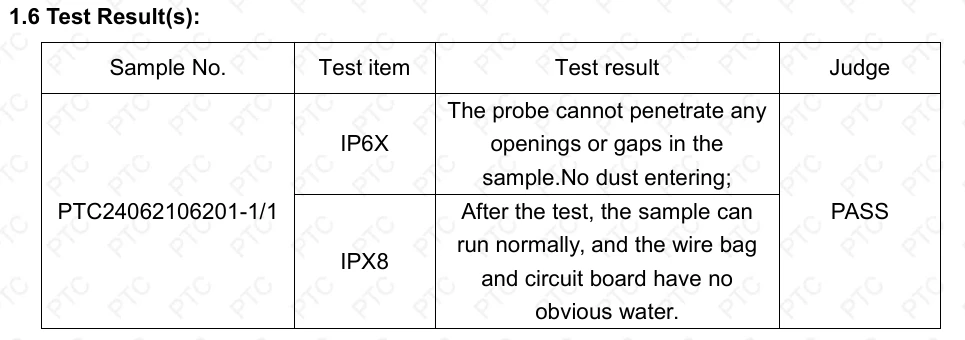
The report records PASS for the tested sample. No dust ingress was reported, and the sample could run normally after immersion testing. The report noted no obvious water on the winding assembly and circuit board.

Report excerpt from page 3: IP6X and IPX8 results and the PASS assessment.
The photographs below show the sample before testing, the IP6X probe check, the dust chamber, and the IPX8 test equipment. They are original report photographs, unlike the conceptual illustration at the beginning of this article.
Report excerpt from page 3: sample and laboratory test photographs.
Results apply to the sample tested. Request confirmation for your selected model and installation. The report records normal operation after testing; confirm powered submerged operation separately if your application requires it.
Selecting a fan for your equipment
For outdoor cabinets, energy storage systems, and industrial equipment, assess ingress protection alongside thermal performance. Your fan must deliver the required airflow at the system operating resistance while meeting temperature, noise, and service-life targets.
CCHV Pro Tip: Before approving an IP68 fan, request the report for the relevant model and verify immersion depth, duration, powered operating status, and connector protection. For coastal sites or equipment exposed to cleaning chemicals, request separate corrosion or material compatibility evidence.
Frequently asked questions
Can an IP68 fan operate underwater?
Only when the manufacturer explicitly approves the intended operating conditions. Confirm whether the fan was running during immersion testing and whether the tested conditions match your application. The CCHV report described here records normal operation after the test.
What is the difference between IP67 and IP68 fans?
Both indicate dust-tight protection. IP67 covers temporary immersion under defined conditions, while IP68 covers continuous immersion under specified conditions. Compare the documented depth and duration when evaluating models.
Does IP68 protect against saltwater and chemicals?
IP68 alone does not establish resistance to saltwater, oils, detergents, or chemicals. For these exposures, request separate corrosion testing and material compatibility evidence.
Does an IP68 rating guarantee a longer lifespan?
No. The rating describes ingress protection rather than operating life. Evaluate lifetime data at your operating temperature, together with bearing type, duty cycle, and mounting orientation.
What should you include in an IP68 fan RFQ?
Provide dimensions, voltage range, airflow and static pressure at the operating point, noise limit, temperature range, control signals, connector, and annual quantity. Describe dust and water exposure and any required immersion or corrosion tests.
For model selection, share your cooling requirements and environmental conditions with CCHV so you can evaluate suitable fan options.